
I want to tell you about the afternoon I stopped fighting with content and started building systems instead.
This is not a guide about prompting ChatGPT to write better blogs. This is about something I did not expect to be possible, building a fully functional, custom AI-powered software tool as a marketer, in a single afternoon, with no developer, no budget, and no code written by hand.
The Problem I Was Living With
My job at Signiance involves a lot of content. We are an AWS consulting partner working with startups across cloud architecture, DevOps, generative AI, security, and cost optimisation. Our audience is technical, our work is nuanced, and the blogs we publish need to reflect that. The reality of how I was writing those blogs before this? A mix of writing manually and using basic AI prompts. And it was frustrating in every direction at once. The blogs did not sound like Signiance. When I used AI to help, I got something that read like every other cloud consulting blog on the internet. Generic. Safe. Hollow. It had none of the voice of a team that actually builds on AWS every day for real clients. It took too long. Even with AI assistance, I was spending hours per blog because I was essentially rewriting everything that came out. The AI gave me a starting point, not a finish line.
There was no consistent structure. Every blog was a different shape. Different number of sections, different meta description quality, different CTA approach. Nothing was standardised. And without a standard, SEO suffered, brand consistency suffered, and scaling was impossible. I kept thinking: we help startups build cloud infrastructure that is automated, reliable, and consistent. Why is our own content operation a manual, inconsistent mess?
Where the Idea Came From
The idea came from frustration, honestly. Not inspiration.
I was staring at a blog I had just finished, one that had taken me about three hours, and I was looking at it thinking, this could have come out ofany cloud agency in India. It did not sound like us. It did not reflect what we actually know. The problem was not that I was bad at writing. The problem was that I had no system. Every blog started from zero. Every time, I was making the same decisions about structure, tone, and SEO from scratch. And AI tools were not solving that, they were just giving me a faster way to write something generic.
What I actually needed was a tool that knew Signiance. Knew our framework. Knew our tone rules. Knew our services. And could apply all ofthat automatically, every single time, without me having to re-explain it. I had been working with Claude for a while at this point, and I had noticed something. When you give Claude enough context and enough constraints, it does not just follow instructions, it builds things. Real things. Functional things.
So I asked myself: what if I could build a custom tool through conversation? What if I described exactly what I needed, step by step, and Claude just built it? That afternoon, I found out the answer was yes.
How I Built It
I want to be clear about what I mean when I say I built this. I did not write code. I do not have a development background. What I did was think very carefully about what I needed, describe it precisely, and work with Claude iteratively across a structured conversation.
The whole thing took one afternoon across eight structured prompts.
Prompt 1 was about context. I introduced Signiance , what we do, who we serve, what our services are. I explained that I needed a browser-based dashboard, not a chat interface, and that it had to work as a single HTML file.
Prompt 2 was about categories. I defined three types ofblogs we publish: Informative (thought leadership, educational), Trending (emerging tech and industry shifts), and Guide/Tutorial (practical, actionable, step-by-step). Each needed its own tone and structure.
Prompt 3 was the most important one. I defined the blog framework. Every section, every rule, every constraint. Blog Title must contain the keyword. Meta description can never use words like “learn,” “discover,” or “unlock.” Introduction can never open with “In today’s world.” Minimum 1,250 words. No em dashes anywhere. This prompt locked in the brand voice permanently.
Prompts 4 through 8 built out the dashboard itself, the SEO scoring system, the image generation, the social post generator, and the refinement tools.
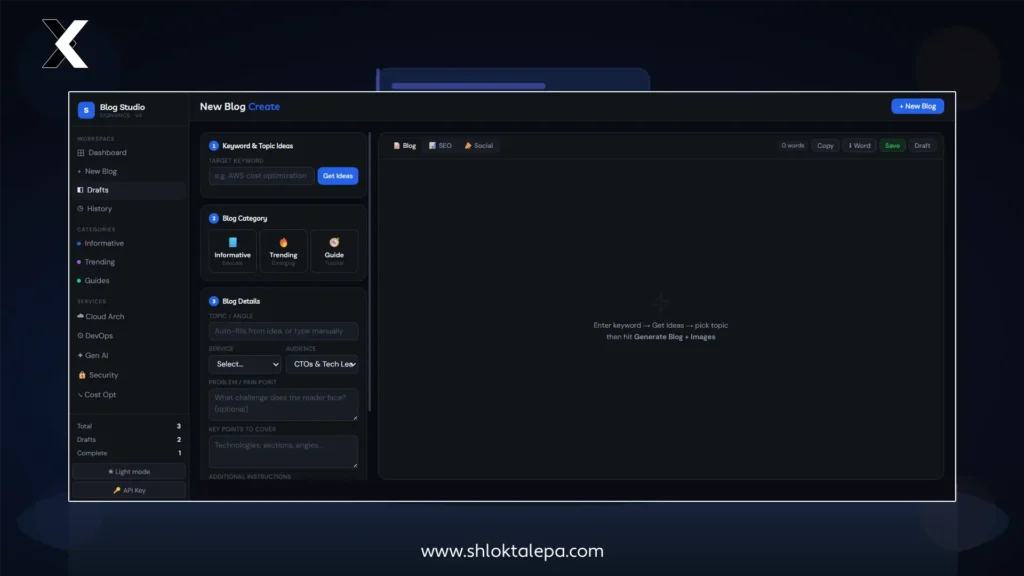
By the end ofthe afternoon, I had a working application. A real dashboard. A sidebar with navigation. A form that took a keyword, generated five topic ideas, let me pick one, fill in the details, and produce a complete publish-ready blog in under 20 seconds.
The moment I knew it had actually worked was not when the first blog came out. It was when I saw the SEO score appear automatically after generation , a score out of 100 across seven checks: keyword in the title, keyword in the meta description, word count, keyword
density, meta length, no buzz words, and H2 structure. Each failed check showed the exact fix needed. That was the moment I realised this was not a toy. This was a production tool.
What It Does Now
The studio today does the following, every time, automatically: A keyword goes in. Five targeted topic ideas come out. I pick one, select the category, fill in the audience and any specific angles, and hit generate.
Within 20 to 30 seconds, I have a complete blog in the Signiance framework, 1,250 words minimum, properly structured, written in our voice, with a topic-specific CTA that mentions Signiance once and does not sound like a template. An SEO score appears immediately. If anything fails, the fix is listed right there.
I can apply targeted edits through an inline refine bar , sharpen the introduction, strengthen the CTA, add a section, fix the meta description , without rewriting the whole blog. One click generates a LinkedIn post and a Twitter/X thread from the same blog.
The blog downloads as a properly formatted Word document, ready for review or publishing. Everything saves across browser sessions, full history, draft management, and filtering by category and service area. The whole thing runs in a browser. It calls the Anthropic API directly. It costs me roughly $0.05 to $0.10 per complete blog generation. Right now, two of us at Signiance are using it. The plan is to roll it out to the rest oft he team.
What It Actually Costs Per Blog
This is the part that surprises people most when I tell them. The studio runs on the Anthropic API using Claude Sonnet. The cost per full blog generation, including the SEO check and a social post, is between $0.05 and $0.10. For 20 blogs a month, you are looking at $3 to $7 in API costs.
That is it.
No subscription to a writing platform. No seat licenses. No monthly SaaS fee. No vendor lock-in. The tool belongs to you completely. The only running cost is the API usage, which scales linearly with how much you generate.
Compare that to the writing tools most marketing teams use, $99 to $299 a month, with none of the brand customisation, none of the framework consistency, and none of the control. The biggest cost in this whole project was the afternoon I spent building it.
What This Changed for Me
I stopped thinking about blogs as something I write. I started thinking about them as something my system produces. That is a different relationship with content. When you have a system, your job becomes deciding what to say, not figuring out how to say it every single time. The creative energy goes into choosing the angle, identifying the insight, picking the keyword , not wrestling with word count, structure, and SEO checks on every piece.
We went from publishing sporadically to publishing consistently. The quality is higher because the framework is enforced every time, not just when I remember to enforce it. The SEO is better because the checks run automatically, not when I think to do them manually.
The thing I keep coming back to is this: we spent one afternoon building something that now does hours ofwork for us every week. That ratio does not happen very often.
Why I Am Writing This
I am writing this because I think a lot of founders and marketers are sitting with the same frustration I had, and they do not realise this is buildable.
They are writing manually or fighting with generic AI output, and they think the only alternative is to hire someone or buy another SaaS subscription. But there is a third option, and most people have not tried it yet. You can build your own tools. Custom, specific, branded tools that know your company, your voice, your framework. Tools that cost almost nothing to run and that you own completely.
I am not a developer. I understood the concept ofwhat I wanted to build, but I needed help executing it. Claude was that help. The skill I actually needed was knowing what to ask for, breaking the problem down into pieces, being specific about constraints, and being willing to iterate.
If you are a SaaS founder spending too much on content and not getting consistent output, I can build you something like this. If you are a startup founder who needs a content system but has no developer on the team, I can help. If you are a marketer who knows what you need but does not know how to get there technically, this is exactly the gap I can fill. The blog studio was the first thing I built this way. It will not be the last.
The Conclusion Nobody Tells You
The most powerful thing AI can do for your business is not write one piece of content for you. It is help you build the system that produces every piece of content for you, consistently, at scale, in your voice, for almost nothing. That is the shift. From using AI as a tool to using AI to build tools. If you want to talk about what that could look like for your business, you know where to find me.